On Page SEO: The Complete Guide to Optimizing Every Page for Search Engines
Introduction
Every page on a website sends signals to search engines about what it’s about, how trustworthy it is, and how well it answers a searcher’s question. Getting those signals right — through titles, content structure, internal links, and technical details — is the entire discipline of on page SEO, and it remains one of the most foundational, controllable levers a business has for improving search visibility.
At DigiOrx, our on page SEO work focuses on making every individual page as clear, relevant, and search-friendly as possible, since even the strongest overall SEO strategy falls short if individual pages aren’t properly optimized. This guide walks through everything involved in on page SEO — what it includes, why it matters, and exactly how to optimize a page step by step for better search performance.
Unlike off-page factors like backlinks, which depend partly on other websites, on page SEO is almost entirely within a business’s direct control, making it one of the most valuable places to focus SEO effort and attention.
What Is On Page SEO?
On page SEO refers to all the optimization work done directly on a specific webpage to help it rank higher in search results and provide a better experience for visitors. This includes content quality, HTML elements like titles and headings, internal linking, and technical factors like page speed and mobile-friendliness.
On Page vs. Off Page SEO
On page SEO covers everything you can control directly on your own website, while off page SEO refers to external factors like backlinks and brand mentions from other websites. Both play an important role, but on page SEO forms the foundation everything else builds upon.
On Page vs. Technical SEO
Technical SEO and on page SEO overlap significantly, though technical SEO often refers more broadly to site-wide factors like crawlability and indexing, while on page SEO focuses specifically on optimizing individual pages for relevance and user experience.
Core Elements of On Page SEO
Title Tags
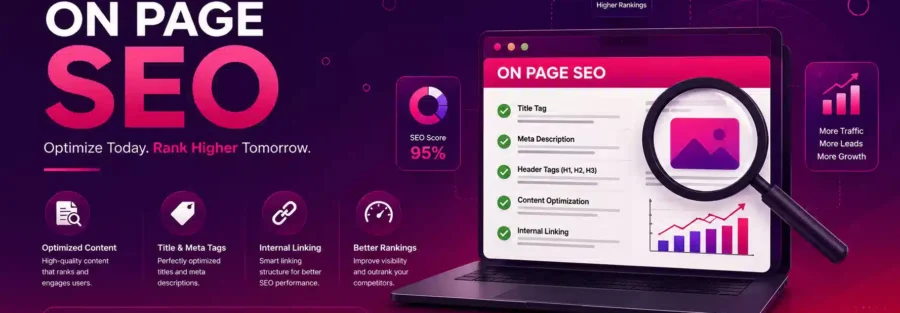
The title tag is one of the most important on page SEO elements, appearing as the clickable headline in search results and playing a significant role in how search engines understand a page’s topic.
Meta Descriptions
While not a direct ranking factor, a well-written meta description influences click-through rates by giving searchers a clear, compelling reason to choose your page over competing results.
Header Tags (H1, H2, H3)
Properly structured headers organize content logically, making it easier for both readers and search engines to understand a page’s structure and the relative importance of different sections.
URL Structure
Clean, descriptive URLs that clearly reflect page content help both search engines and users understand what a page is about before ever clicking through.
Content Quality and Relevance
Comprehensive, genuinely useful content that thoroughly addresses a searcher’s query remains one of the most important on page SEO factors, since search engines prioritize content that best satisfies user intent.
Internal Linking
Strategic links between related pages on your own website help distribute authority throughout your site and guide both users and search engines toward related, relevant content.
Image Optimization
Descriptive file names, proper alt text, and appropriately compressed image files all contribute to both accessibility and search performance.
Schema Markup
Structured data helps search engines understand specific types of content — reviews, products, events — more precisely, sometimes unlocking enhanced search result features like star ratings or rich snippets.
Writing Effective Title Tags
Keeping Titles Within Optimal Length
Titles that are too long get truncated in search results, while overly short titles may miss opportunities to include valuable keywords and context, making a balanced length important for both display and relevance.
Placing Important Keywords Early
Positioning your primary keyword near the beginning of a title tag tends to carry slightly more weight for both search engines and human readers scanning results quickly.
Making Titles Compelling, Not Just Accurate
A title tag should be accurate but also compelling enough to encourage clicks, since strong click-through rates can themselves become a positive signal reinforcing a page’s relevance over time.
Avoiding Keyword Stuffing
Repeating the same keyword multiple times within a single title tag looks unnatural to both readers and search engines, potentially undermining trust and click-through performance rather than helping it.
Crafting Meta Descriptions That Drive Clicks
Summarizing the Page’s Value Clearly
A strong meta description clearly communicates what a searcher will find on the page and why it’s worth clicking, functioning much like ad copy for organic search results.
Including a Natural Keyword Mention
While not a direct ranking factor, including your target keyword naturally within the meta description helps reinforce relevance and often appears bolded in search results, drawing additional attention.
Staying Within Display Length Limits
Meta descriptions that exceed typical display limits get truncated, so keeping key information within the visible character count ensures your full message reaches searchers browsing results.
Writing Unique Descriptions for Every Page
Duplicate or missing meta descriptions across multiple pages waste an opportunity to differentiate each page’s specific value, so unique, tailored descriptions for every important page are worth the extra effort.
Structuring Content With Header Tags
Using a Single H1 Per Page
Each page should have one clear H1 tag that represents the main topic, providing both users and search engines with an immediate, unambiguous understanding of the page’s primary focus.
Organizing Subtopics With H2 and H3 Tags
Breaking content into logical sections with H2 and H3 headers improves readability and helps search engines understand the specific subtopics covered within a broader page.
Incorporating Keywords Naturally Into Headers
Where relevant and natural, incorporating target keywords or closely related terms into headers reinforces topical relevance without resorting to forced, unnatural phrasing.
Maintaining a Logical Hierarchy
Headers should follow a clear, logical structure — H1 followed by H2s, with H3s nested appropriately underneath relevant H2s — rather than skipping levels or using headers purely for visual styling.
Optimizing URL Structure
Keeping URLs Short and Descriptive
Concise URLs that clearly reflect page content are easier for users to read, share, and remember, while also giving search engines a clear, immediate signal about page topic.
Using Hyphens to Separate Words
Hyphens are the standard, search-engine-friendly way to separate words within a URL, improving both readability and how search engines parse the URL’s content.
Avoiding Unnecessary Parameters and Numbers
Clean, static-looking URLs generally perform better and appear more trustworthy to users than URLs cluttered with unnecessary parameters, session IDs, or arbitrary numbers.
Maintaining Consistency With Site Structure
URLs that reflect a logical site hierarchy — such as nesting blog posts under a clear “/blog/” path — help both users and search engines understand how content relates to the broader website structure.
Content Optimization Best Practices
Thoroughly Answering Search Intent
Understanding exactly what a searcher is looking for, and ensuring your content fully addresses that need, remains one of the most important on page SEO factors influencing both rankings and user satisfaction.
Using Keywords Naturally Throughout Content
Rather than forcing exact-match keywords repeatedly, using your target keyword and closely related variations naturally throughout the content helps reinforce relevance without harming readability.
Maintaining Appropriate Content Length
While there’s no universal ideal length, content should be as comprehensive as genuinely necessary to fully address a topic, since overly thin content often struggles to rank for competitive search terms.
Updating Content Regularly
Periodically reviewing and updating existing content with new information, statistics, or examples helps maintain relevance and can positively influence rankings over time, particularly for topics that evolve.
Formatting for Readability
Short paragraphs, bullet points, and clear formatting improve the user experience significantly, particularly for readers scanning content on mobile devices.
Internal Linking Strategy
Connecting Related Content
Linking between genuinely related pages on your own website helps search engines understand relationships between topics while guiding users toward additional relevant content.
Using Descriptive Anchor Text
Rather than generic phrases like “click here,” using descriptive anchor text that reflects the linked page’s topic provides additional context to both users and search engines.
Prioritizing Important Pages
Strategic internal linking can help direct more authority toward your most important pages, such as key service or product pages, by linking to them frequently from relevant, related content.
Avoiding Excessive or Irrelevant Links
Too many internal links, or links to unrelated content, can dilute their effectiveness and create a confusing experience for users trying to navigate a page’s content.
Image and Media Optimization
Writing Descriptive Alt Text
Alt text should accurately describe an image’s content, serving both accessibility purposes for visually impaired users and providing additional context for search engines.
Compressing Images for Speed
Large, uncompressed images slow down page load times significantly, making proper compression an essential part of maintaining strong page speed alongside visual quality.
Using Descriptive File Names
Renaming image files with descriptive, keyword-relevant names before uploading, rather than leaving generic camera-generated file names, provides an additional relevance signal to search engines.
Choosing Appropriate Image Formats
Modern image formats often offer better compression and quality compared to older formats, contributing to faster page load times without sacrificing visual quality.
Common On Page SEO Mistakes to Avoid
Duplicate or Missing Title Tags and Meta Descriptions
Failing to create unique titles and descriptions for every important page wastes valuable opportunities to differentiate content and improve click-through rates from search results.
Keyword Stuffing
Overusing target keywords unnaturally throughout content, titles, or headers can trigger search engine penalties and creates a poor, awkward reading experience for actual visitors.
Ignoring Mobile Optimization
Since the majority of searches now happen on mobile devices, pages that don’t display and function well on smaller screens directly undermine both user experience and search performance.
Thin or Low-Value Content
Pages with minimal, superficial content struggle to rank for competitive search terms, since search engines prioritize thorough, genuinely useful content that fully satisfies searcher intent.
Broken Internal Links
Links pointing to outdated or removed pages create a poor user experience and can waste the authority-distributing value that proper internal linking is meant to provide.
Neglecting Page Speed
Slow-loading pages frustrate visitors and can negatively impact search rankings, making page speed optimization an essential, often overlooked component of comprehensive on page SEO.
How On Page SEO Fits Into a Broader SEO Strategy
The Foundation for Technical and Off-Page Efforts
Strong on page SEO ensures that when technical improvements and backlinks do drive traffic and authority to your site, individual pages are genuinely ready to convert that visibility into rankings and engagement.
Supporting Content Marketing Goals
Well-optimized on page elements help new content reach its intended audience more effectively, amplifying the value of ongoing content marketing efforts.
Working Alongside Local SEO
For location-based businesses, on page SEO principles apply directly to location and service pages, reinforcing the broader local SEO signals sent through a Google Business Profile and citations.
What Makes DigiOrx’s On Page SEO Approach Different
At DigiOrx, our on page SEO work goes beyond simply inserting keywords into titles and headers. We focus on genuinely improving how well each page answers searcher intent, structuring content clearly, and ensuring every technical element — from meta descriptions to internal links — works together to support both rankings and real user experience.
Whether you need a full-site on page SEO audit or ongoing optimization support for new content, our approach is built around sustainable, white-hat practices that deliver lasting search visibility rather than short-term tricks.
The Role of E-E-A-T in On Page SEO
Demonstrating Experience and Expertise
Content that clearly reflects real, first-hand experience or genuine subject matter expertise tends to perform better in search results, particularly for topics where accuracy and trustworthiness matter significantly to searchers.
Building Authoritativeness Through Content Depth
Thorough, well-researched content that genuinely covers a topic comprehensively helps establish a page — and the broader website — as an authoritative source within its subject area.
Establishing Trustworthiness
Clear author information, transparent sourcing, and accurate, up-to-date content all contribute to trustworthiness, an increasingly important factor in how search engines evaluate content quality.
Applying E-E-A-T to On Page SEO Practically
Including author bios, citing credible sources, and regularly updating content to reflect current information are practical ways to strengthen E-E-A-T signals as part of a broader on page SEO strategy.
On Page SEO for Different Types of Pages
Homepage Optimization
A homepage typically needs broader, brand-focused optimization, balancing overall business relevance with clear navigation toward more specific service or product pages.
Service and Product Pages
These pages benefit from detailed, specific content addressing exactly what a potential customer needs to know, along with clear calls to action guiding visitors toward a conversion.
Blog and Informational Content
Educational content benefits from thorough, well-organized information that fully answers a searcher’s question, often supported by related internal links to relevant service pages.
Location and Local Service Pages
For location-based businesses, these pages need location-specific content and keywords, reinforcing relevance for searches tied to a particular geographic area.
Tools That Support On Page SEO Work
Keyword Research Tools
Specialized tools help identify relevant keywords, their search volume, and competitiveness, informing decisions about which terms to target across titles, headers, and content.
SEO Auditing Software
Comprehensive auditing tools can quickly identify on page issues like missing meta descriptions, duplicate titles, or broken internal links across an entire website.
Content Optimization Platforms
Some tools analyze existing top-ranking content for a given keyword, offering guidance on content length, related terms, and structure that tends to perform well for that specific topic.
Page Speed Testing Tools
Dedicated speed testing tools help identify specific technical issues slowing down page load times, providing actionable recommendations for improvement.
A Practical On Page SEO Checklist
- Every important page has a unique, keyword-relevant title tag.
- Every page has a unique, compelling meta description.
- Each page uses a single, clear H1 tag with logical H2 and H3 structure.
- URLs are short, descriptive, and consistent with your site structure.
- Content thoroughly addresses searcher intent for its target keyword.
- Images include descriptive alt text and are properly compressed.
- Internal links connect related content using descriptive anchor text.
- Pages load quickly and function well on mobile devices.
Working through this checklist regularly helps ensure your on page SEO remains strong as your website continues to grow.
Frequently Asked Questions
How is on page SEO different from off page SEO? On page SEO covers everything you control directly on your own website — content, titles, headers, and internal links — while off page SEO refers to external factors like backlinks and brand mentions from other websites.
How often should on page SEO be updated? Regularly reviewing and updating key pages every few months, along with optimizing every new piece of content from the start, helps maintain strong on page SEO performance over time.
Does on page SEO still matter if I have strong backlinks? Yes. Strong backlinks help build authority, but poorly optimized pages can still struggle to rank or convert that authority into actual traffic and engagement without solid on page SEO fundamentals in place.
What’s the most important on page SEO factor? While all elements matter, thoroughly satisfying searcher intent through genuinely useful, well-organized content is generally considered the most influential on page SEO factor, since search engines prioritize the pages that best answer a searcher’s query.
Can I do on page SEO myself, or do I need a professional? Many on page SEO basics, like writing clear titles and headers, can be handled without professional help, though a deeper technical audit and ongoing strategy often benefit significantly from experienced SEO support.
Conclusion
On page SEO forms the foundation of any successful search optimization strategy, giving businesses direct control over how clearly and effectively their pages communicate relevance to both search engines and real visitors. From title tags and headers to content quality and internal linking, every element plays a role in determining whether a page earns strong rankings and genuinely satisfies searcher intent.
By focusing on thorough, user-first content alongside clean technical execution, on page SEO delivers lasting value that supports every other part of a broader SEO strategy. If you’re ready to strengthen your website’s on page SEO, DigiOrx offers professional SEO services tailored to your specific business goals — reach out today to get starte